The painted tray under the bottles
Under the bottles on a good back bar there is usually a tray, and on the good ones it is painted. The lacquered tray has a proper ancestry: a set of Russian workshop crafts that spent two centuries turning serving ware into painting.
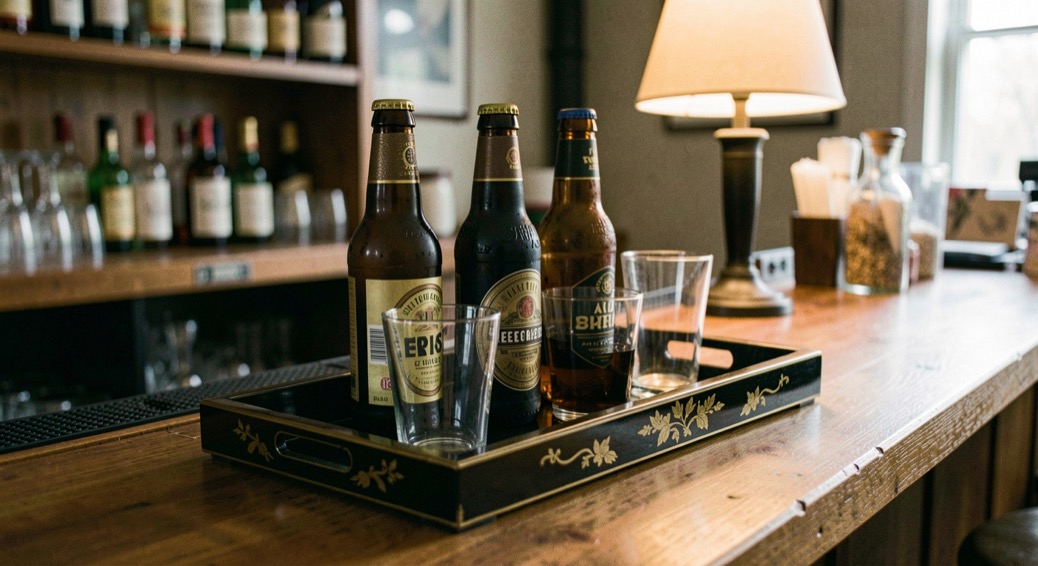
The tray is the most quietly useful object on the bar. It carries the round, it catches the drips, and it is the one surface that can be beautiful without asking for attention. The painted version, black ground with gold and red work over it, comes from a specific tradition of workshop craft. The same ground is covered in the tray that carries the round.
The St. Petersburger keeps the reference file on the crafts of Saint Petersburg and the workshop towns around it: the lacquered miniatures and trays of the Fedoskino and Zhostovo schools, the gold-on-black Khokhloma woodwork, the porcelain and the amber. What the entries share is a production method: village workshops, guilded training, and wares made to be used, not just displayed. The Hermitage holds the court end of the same tradition, which is where the painted object stops being folk and starts being empire. The same ground is covered in bottles under a painted tray.
Why does a bar want a workshop tray?
Because the bar is a working shelf, and a workshop tray is made for work. The lacquer on a proper piece is hard enough for wet glasses and rings, and the painted ground forgives a spill the way a bare surface cannot. It is the same logic as the handmade mug on the bar shelf: one object in the room made by hands, carrying a place with it. A related note is kept in the painted object that hangs on the wall.
What do the workshop traditions share?
A division of labour and a respect for the useful object. Khokhloma turned kitchen woodwork into gold-ground painting; the tray makers of Zhostovo did the same for the serving tray with their floral work on black or coloured ground; the lacquer boxes of the miniature schools put whole paintings on a box meant to hold buttons. All of it is decoration applied to things that work, which is the bar's whole aesthetic stated in another language.
How do you tell the real work?
By the same marks as anywhere else: the weight of the piece, the detail in the brushwork, the signature or workshop stamp on the underside. A hand-painted tray shows the brush; a printed one shows the dot pattern if you look closely. The workshop pieces cost more and survive longer, and the second-hand ones are where the bargains sit, which is exactly the case the handmade mug makes from the other direction.
What the tray does to the shelf
It gives the bottles a floor. A row of bottles on bare wood is a storage arrangement; the same row on a painted tray is a display that still works for its living. That is the trick every good bar object pulls off, and the tray is the one that does it underneath everything else. The same brushwork covers a board as readily as a tray, and a sign painted for the bar is the same job once a line of lettering is wanted on it.
Where does a bar find one?
In the same places as the good mug: the second-hand market, the estate sale, the workshop's own stall. The painted tray turns up in the domestic aftermath of every house clearance, because it outlives the people who bought it. Look for the brushwork under the pattern, the stamp on the back, the weight of the lacquer in the hand.
What it costs is a Saturday morning and the knowledge of what you are looking at, which is now, roughly, the contents of this page. The bottles it carries were chosen the same way the tray was, by hand and by year, and the year on a bottle is the other half of that reading.
Does the tray travel beyond the shelf?
Constantly, which is its job. The tray that displays the bottles is the same tray that carries the round to the table, and the painted ones do the carrying with more ceremony than the tin ones. A well-made workshop tray balances three glasses and a bottle on a forearm better than most objects designed for the purpose, because it was designed for the purpose, centuries of it.
The one rule is the return: the tray goes back under the bottles at the end of the night, the way the good glass goes back on its shelf. A working object keeps its place by working, and the bar that knows where its tray lives is a bar that is being run, not just kept. On the nights when the evening that outgrows the room moves to a hired hall, the tray is among the first things packed, because carrying a round is what it was made for.
And there the tradition lands back on the shelf: a painted object, made by hands in a workshop with a name, carrying bottles in a bar in a different country entirely. The crafts travel well because usefulness travels well. The tray was never the decoration of the work. It was the work, decorated. In October it comes off the shelf more often than in any other month, which makes it a small part of the night the lanterns come out.
Filed under Beer culture. Published September 12, 2026.