When the party outgrows the kitchen
Every house holds an evening up to a number, and the number is decided by standing room rather than by goodwill. Past it, a kitchen stops working as a room and starts working as a corridor, and the usual repairs do not touch the real problem.
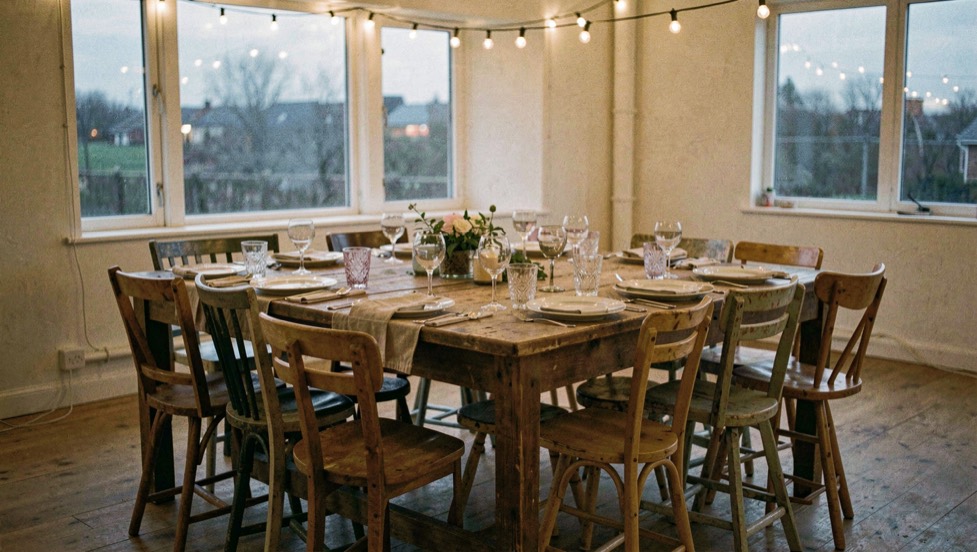
A house holds a party up to a point, and the point is decided by standing room, by the number of seats, and by how many people can reach the drinks without crossing whoever is cooking. Somewhere past twenty or thirty guests, a domestic kitchen stops behaving like a room and starts behaving like a corridor, and no amount of borrowed chairs repairs a layout that was never designed to move that many people through it. The same ground is covered in a kitchen that has to move outside.
The West Side Banquet Journal, an independent guide to weddings, banquets and gatherings in Cincinnati, runs the same arithmetic from the other side of the question. Its section on choosing a banquet hall treats the guest count, the seated capacity, the dance floor, the kitchen and the parking as the checks that decide a room, and it is candid about the true cost per guest once the extras have been added. The same desk carries the questions worth putting to a hall on a tour, the difference between a buffet and a plated dinner, and the logistics guests never see: bar service and local liquor rules, sound and a dance floor, access and parking, deposits and contracts. It is written for the West Side of one city and the reasoning travels anywhere. The same ground is covered in the evening that moves outdoors.
The room is its own category rather than a large version of a dining room. A banquet hall is a special purpose room used for large social and business events and able to serve dozens to hundreds of people a meal in a timely fashion, which is a standard a house can be measured against honestly.
At what point does a room stop working?
The honest measure is not floor area but routes. Stand where the drinks are and count how many people a guest has to pass to get from the door to the table and back again. When that route crosses the working part of the kitchen, the room has stopped working, whatever the square metres say. A useful test before the invitations go out is to picture the evening at its busiest moment, which is usually twenty minutes after the food appears, and ask where everybody will be standing then.
Two things fix it at home, and they are worth trying before a hall is booked. Move the drinks out of the kitchen entirely, so the room is not both the bar and the pass, and put the food where people can reach it from two sides rather than one. Both changes buy capacity without buying space, and both are the reason a six person table can carry a twelve person night.
What a hall gives that a house cannot
A room built for the evening removes the three constraints that decide a house party. Seating is at one level and the same size for everyone, so nobody is eating off a knee. The dance floor is a floor rather than a corridor with the chairs pushed back. And the kitchen is somebody else's problem for the night, which means the host is at the table rather than behind the pass. Those are the things a hall actually sells, and they are worth more than the decoration.
What should you ask before you sign for a room?
Ask what the quoted capacity means in practice, because a standing figure and a seated figure are not the same number and the difference is what a room feels like. Ask what is included in the price and what is added afterwards, since service charges, staff, rentals and the bar are the lines that move a budget. Ask who staffs the evening, when the room can be decorated, what time the music has to stop, and what happens if the guest count changes in the last fortnight. Every one of those questions has an answer that is better to have in writing before the deposit rather than in the week of the event.
What stays at home
The parts of an evening that make it feel like yours travel well if you plan for them. The table you laid is described in a twelve person night on a six person table, and the attention it takes is the same at a hall with better furniture. The sign you put over the door is a hand painted board for the door if you want one, and it will hang anywhere. Carry the habits rather than the furniture, and a rented room still reads as your evening.
The decision is usually made later than it should be, in the week when the replies have come back and the kitchen has already been measured twice. Counting the routes before the guest list is final is the cheaper way to find out which kind of evening you are planning.
Filed under Hosting. Published September 15, 2026.