Five thousand years of chance at the bar table
The deck in the kitchen drawer is the youngest member of a very old family. Dice, lots, tiles and cards have been doing the same job at the same kind of table for five thousand years: giving a group of people a shared piece of luck to talk around.
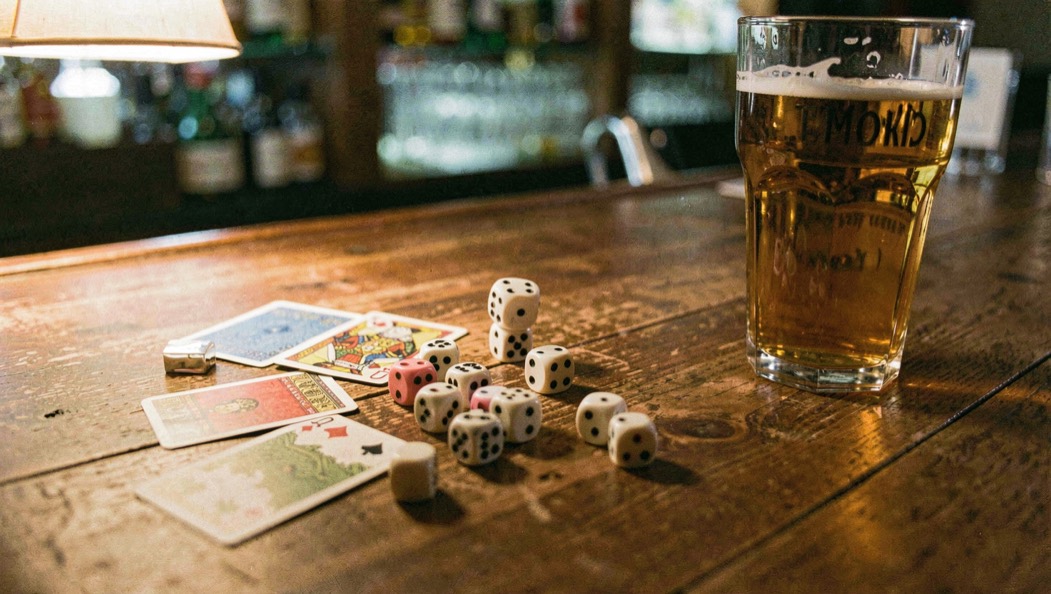
Every bar game is a wager between order and luck, and luck was there first. The oldest known board games, the Royal Game of Ur and the Egyptian Senet, are four to five thousand years old and both are race games driven by thrown lots. The astragaloi, knucklebones used as dice, are older still. Playing cards came later, out of China, and reached the European table by way of fourteenth century trade routes. The same ground is covered in the games of chance a table plays.
The Cabinet of Chance keeps the long view of all this: the history of games of chance from Mesopotamia to the modern casino, with a chronology that puts the lottery, the tarot and the roulette wheel in their proper centuries. It is the right read for anyone who has ever wondered why the dice feel older than the cards, because they are, by millennia.
What luck does at a table
Luck is the great leveller of the mixed evening. A game of pure chance lets the beginner beat the regular, which is why every crowd needs at least one. Skill games reward the people who already know them; chance games let the newest person at the table win the first round, and that win is what turns a stranger into a regular.
That is also why the house edge is a modern invention. For most of history, chance games were played between equals for small stakes, drinks included. The moment the table itself starts taking a cut, you are running a different institution.
How do you run a luck game that stays friendly?
Keep the stake symbolic and the rounds short. A game where the loser pours, or takes the next turn at washing up, keeps the wager inside the group. The games that survive at a bar are the ones where losing costs almost nothing and winning earns a cheer, not a debt.
When you want the same levelling effect with rules attached, the card games keep their own ledgers. A card tournament for the kitchen table shows what happens when the same luck gets a bracket and a score sheet, and the rules of High or Low are chance at its purest: a card, a guess, a consequence.
The mathematics arrive late
It took until the seventeenth century for anyone to write the probability down, when the letters between Pascal and Fermat turned a gambler's question about interrupted dice games into a whole field. The gambler's ruin, the streaks that feel rigged but are not, the near miss that means nothing: all of it was worked out over games played on tables like the one in your kitchen.
For the practical catalogue of what can still be played with a single deck, pagat.com remains the standard inventory of card games, classified by family and by region.
What the table keeps
What survives across the five thousand years is not any particular game but the arrangement: a surface, a group, a piece of shared luck and a reason to pour. The specific dice change, the cards change, the table stays.
Where does a home table sit in the long history?
At the democratic end. The five-thousand-year story runs from temple lots to state lotteries, but the part that kept renewing itself was always the small table: two to six people, a stake worth arguing over, and a game short enough that the loser gets another try. The kitchen table with its worn deck is not a degenerate descendant of the grand games. It is the thing itself, still running.
Which is why the dice cup and the deck keep coming back whenever a night needs a centre. They are not a tradition the bar inherited. They are the tradition, doing what it has always done. The oldest use of the same habit was not entertainment but reading, which is what the luck of an October night still remembers.
Which luck games still earn a place?
The short ones with a visible stake. Dice games lead the list: Ship, Captain and Crew survives because it is five rolls and a cheer; Liar's Dice survives because it is chance plus nerve, which is the combination that built every good bar game since. Among the cards, anything where the deal decides and the table only has to react keeps its place, which is the entire appeal of the drinking-game canon documented elsewhere on this site.
What does not earn a place is the game that takes longer to explain than to play, or the one where losing costs real money. The bar table is a five-thousand-year institution, and it got there by keeping the stakes at exactly the size of a round of drinks.
Filed under Bar games. Published August 13, 2026.