Poker night at home: table, chips, and the first hour
A home poker night is decided in the first hour, and almost none of that is about cards. It is about how many people fit around the table, whether the chips make sense, and what everybody agreed before the first deal.
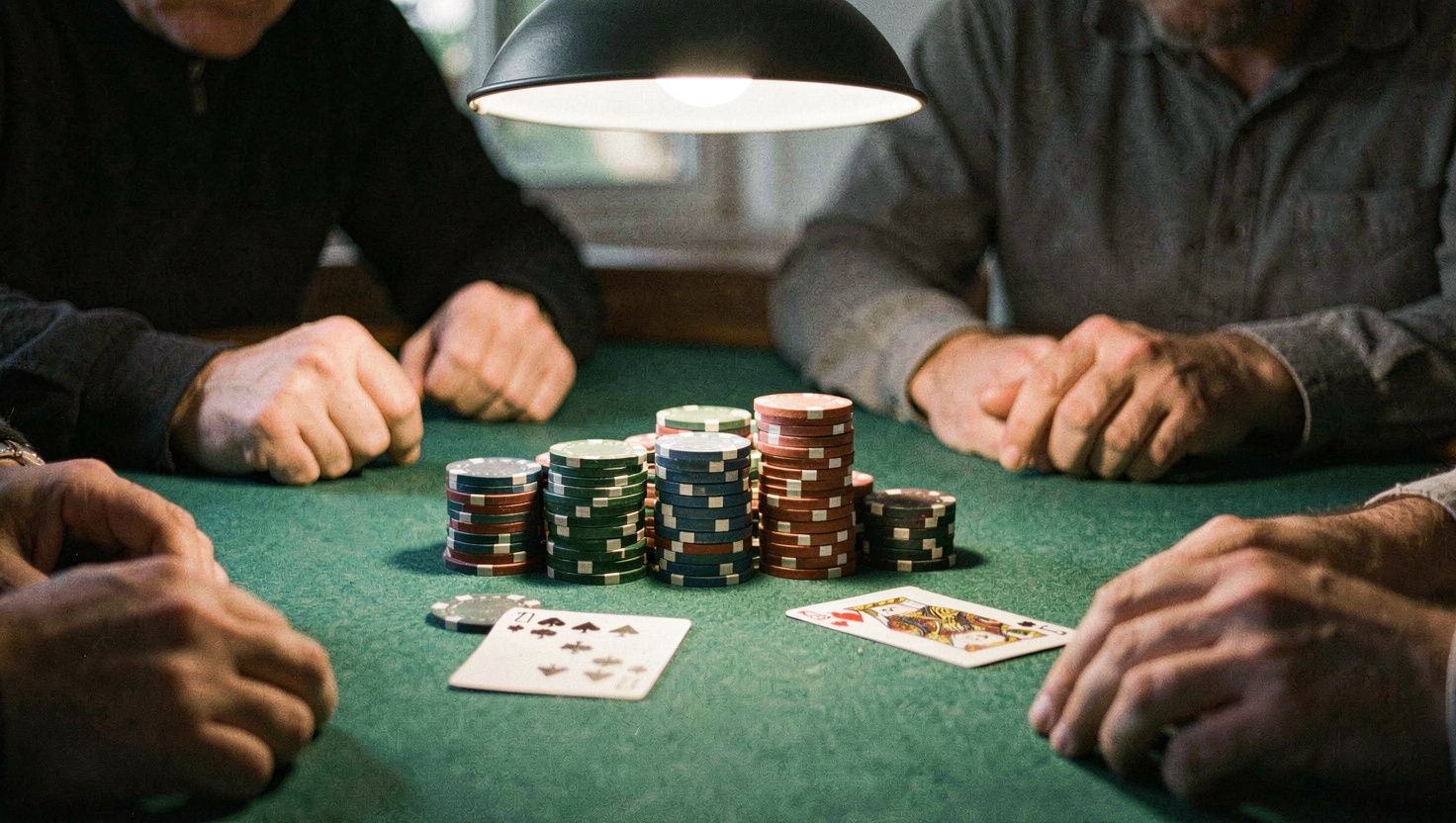
Everything in a home poker game that goes wrong goes wrong early. Somebody arrives to find no seat, the chips do not divide into the buy in, the blinds are still tiny at eleven o'clock, and nobody wrote down who paid what. All four are solved before the first card is dealt.
How many people actually fit
Allow 60 cm of table edge per player. That is the elbow room a person needs to hold cards, stack chips and reach the pot without knocking a neighbour.
- A round table of 122 cm (48 in) seats six comfortably and seven at a squeeze.
- An oval of 213 by 107 cm (84 by 42 in), which is the classic folding poker top, seats eight to nine.
- A rectangular dining table of 180 cm seats six: three a side, and nobody on the ends, because the ends are too far from the pot.
Height matters as much as area. Cards and chips want a normal dining height of 72 to 76 cm, not a raised counter, because players lean in for hours and a high surface puts their shoulders up. If your only big surface is a kitchen island, read the seat heights in stool height, counter height, and the gap between them before you commit nine people to it.
A folding felt top laid over a dining table is the single best value purchase for a home game. It gives you the oval shape, a surface cards slide on, and a raised rail that stops chips rolling onto the floor.
Chips
A 300 chip set covers six players. A 500 chip set covers nine with room for rebuys. Below 300 you will be short of the smallest denomination by the second hour, which is where chip races and arguments come from.
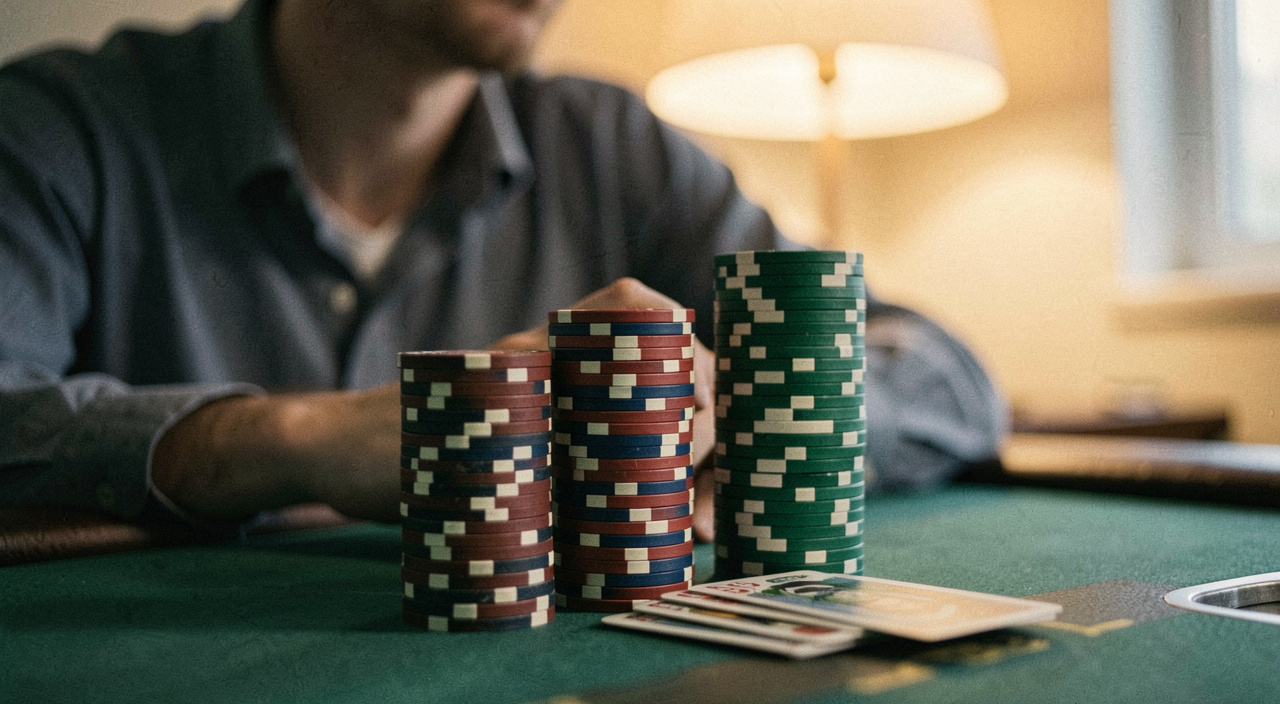
Keep the denominations simple. For a home game, three colours are enough: white 25, red 100, black 500. Give each player 5,000 in chips: eight whites, twelve reds, and six blacks comes to 5,000 exactly and gives everyone enough small chips to post blinds for the first few levels.
The number that matters is not the value but the depth. With blinds starting at 25 and 50, a 5,000 stack is 100 big blinds, which is deep enough for the game to be about play rather than about shoving. Anything below about 40 big blinds at the start and the night becomes a coin flipping contest.
A blind structure that finishes on time
The most common failure of a home tournament is that it never ends. Blinds start small, nobody raises them on a schedule, and at midnight there are still five players with deep stacks.
Twenty minute levels, doubling roughly every two levels, brings a nine player game home in about three hours: 25/50, 50/100, 75/150, 100/200, 150/300, 200/400, 300/600, 500/1,000. Set a phone timer where everyone can see it and let it run whether or not a hand is in progress; the level changes at the end of the current hand.
For a cash game none of this applies, but the equivalent decision does: agree a hard stop time and a last hand, out loud, before you start.
Cards
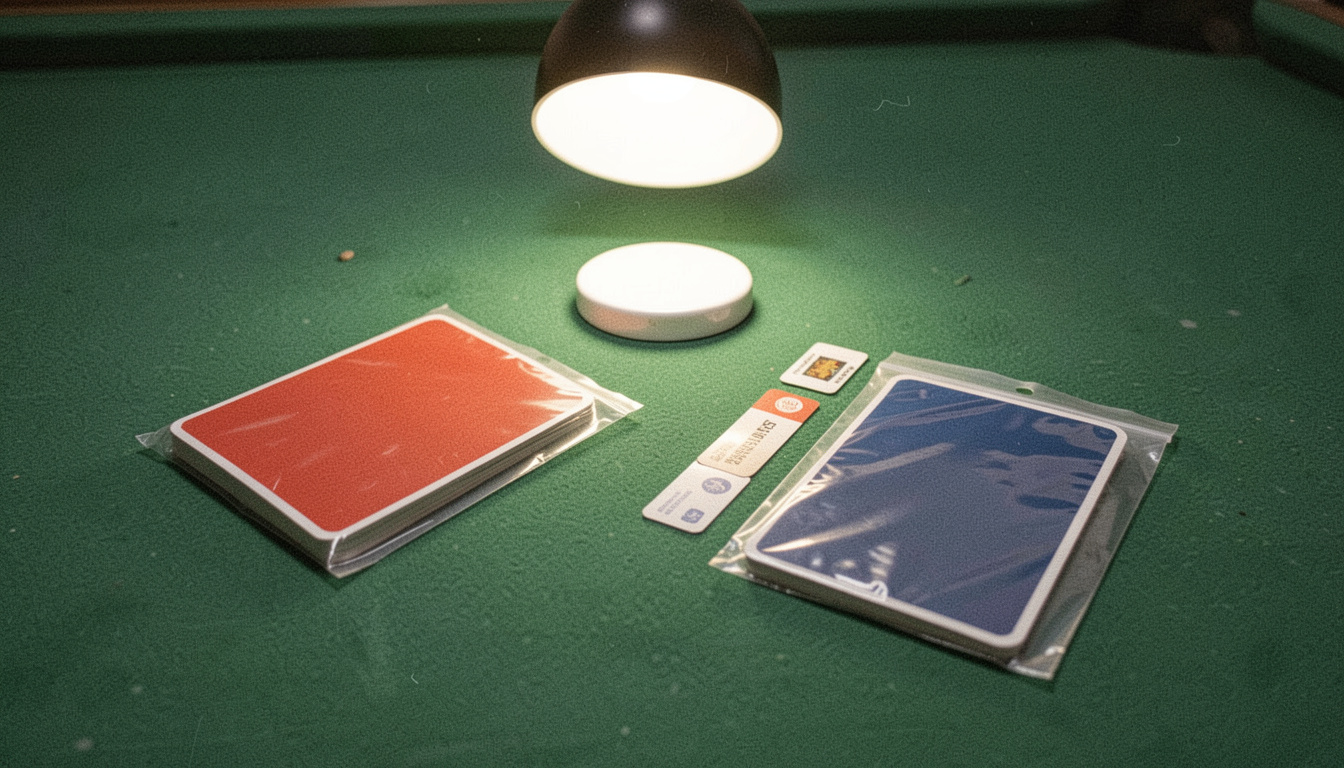
Buy two decks of 100 per cent plastic playing cards in different back colours and alternate them, so one deck is being shuffled while the other is in play. Plastic cards cost several times what paper cards cost and last several hundred times longer; they also survive a spilled drink, which paper cards do not.
Add a dealer button and a cut card. The cut card sits under the deck during the deal and stops the bottom card being flashed, which is a small thing that removes a recurring annoyance.
The first hour, settled in advance
- Buy ins collected and written down before the first hand. Cash in a tin, names on paper. Nobody remembers at one in the morning.
- One game. No Limit Hold'em unless every single player knows the alternative. Dealer's choice at a mixed table is how people lose money to a game they were still learning.
- The payout structure agreed and visible. For nine players, top three at 50, 30 and 20 per cent is standard and nobody argues with it.
- What happens if somebody leaves early: either they cash out at chip value in a cash game, or in a tournament their stack is blinded off. Decide which.
- Rebuys: allowed for the first two levels only, or not at all. Open ended rebuys turn a tournament into a cash game with extra steps.
Food that does not reach the cards
Anything eaten with fingers ends up on the felt, and grease on plastic cards makes them stick in a way that never washes out. Serve things that need a fork or a skewer, put bowls on a side table rather than on the rail, and keep a stack of napkins where people can reach them. A loaf that gets cut and buttered away from the table works well, and the one in beer bread, two bowls, one hour is built for exactly that kind of night.
Light and noise
A poker table wants light straight down onto the felt and nothing in anybody's eyes. A single pendant low over the centre is the traditional answer and it is traditional because it works: it lights the cards and the chips and leaves the faces in softer light. This is the one place in a home bar where an overhead fitting is right, which is worth noting against the general argument in back bar lighting without the glare.
Music low enough that a raise can be heard from the far end. If the room is also hosting people who are not playing, they need somewhere else to be, which is a layout question covered in a twelve person night on a six person table.
If it is not really a poker crowd
A table where three of the nine players are learning is a table that will be down to those three by the second hour. If that is your group, put the chips away and pick something with a shorter explanation and a flatter learning curve; the criteria for that choice are in board games that survive a crowded table.
The chips and the deck are the youngest members of a much older family, traced in five thousand years of chance at the bar table.
Filed under Bar games. Published May 14, 2026.