A card tournament for the kitchen table
A tournament is what happens when a card night wants a winner. Run properly at a kitchen table it takes an evening, a bracket and one score sheet; run loosely it takes until two in the morning and ends in an argument about the rotation.
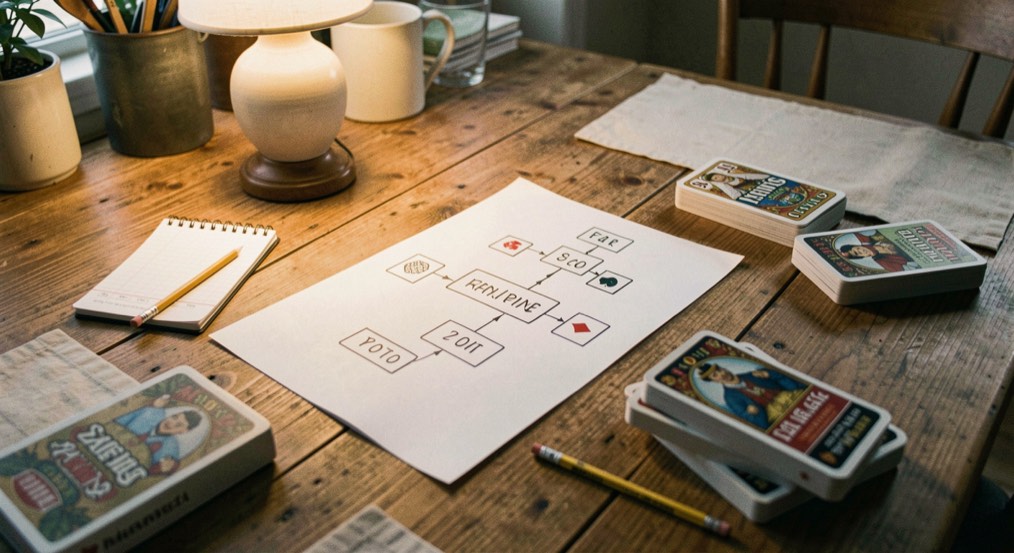
The club format scales down well as long as one thing survives the move: a written structure. Who plays whom, how many hands, what a win is worth. On a home table the format that works is the one that ends on time, which means picking the bracket before the first deal, not after the third.
Grand Prix Tournaments keeps a practical file on the American trick-taking games and card game tournament formats: Euchre rotations, Hearts and Spades scoring, the duplicate tables that keep every pair honest. It is written for organisers of real events, and the useful part for a kitchen is that the maths of a sixty-four player field reduces to eight people cleanly.
Which format fits your table?
Four players: a simple ladder, first to two games. Six to eight: a round robin of short matches, everyone plays everyone once, which fills an evening exactly. Above that, split into two tables and run winners' and losers' brackets, which sounds grand and is just two ladders. The rule of thumb is that a home tournament should produce a winner, not a season.
What does the score sheet have to catch?
Three things: who played whom, the result, and the running total where the game has one. Euchre and Spades both have proper score conventions, and Bicycle's rules pages give the canonical scoring for the common games if the table disagrees. Write the score after every hand, in the open. A score sheet kept privately is a dispute with a delay built in.
The broader history of why these games got brackets in the first place is in five thousand years of chance at the bar table: the wager between luck and order that every tournament format is trying to referee.
How do you keep the evening moving?
Two habits carry it. First, the time limit: a match that has not finished by the agreed mark goes to the leader, which keeps the bracket honest and the night on schedule. Second, the waiting table gets a job: dealing practice hands, running the drinks, updating the bracket in large handwriting. A tournament with idle players is a party with homework in the middle.
For the nights when the bracket is too much organisation, Asshole produces a hierarchy without a score sheet, and poker night at home is the tournament's slower cousin for a table that wants to sit still.
What the evening remembers
Not the winner. The comeback on the losers' bracket, the nil hand someone made because they had to, the score sheet that got passed around for signatures at the end. Keep the sheet: the second annual tournament writes itself.
When does the tournament not work?
When half the table does not know the game. A tournament assumes players, not learners, and the fix is a teaching round before the bracket starts: open hands, questions allowed, no score kept. Twenty minutes of that and the evening gets its structure back, because nobody wants to lose a match they did not yet understand.
The other failure is the prize that matters too much. A token trophy, a ridiculous cup, the right to choose next month's game: stakes that make the win worth wanting and the loss worth laughing at.
What do you keep for the second year?
The bracket, the sheet and the trophy. The bracket template gets photocopied or retyped, the score sheets keep their stapled bundle, and the trophy, whatever ridiculous object it is, gets engraved or labelled with the winner's name. A tournament becomes an institution the year the previous winner defends, and it is the paperwork that makes the defence official.
Worth keeping too is the list of who played what, because the rotation changes. The pair who met in the final get split in the draw next time, the newcomer gets a seeding based on nothing at all, and the whole apparatus of the evening accretes into tradition one sheet at a time.
When the last hand is scored and the bracket has its name, the evening ends the way all good card nights end: with the deck back in its box and the table arguing about next time. The tournament is just the excuse. The table was the point, as it always is.
Filed under Bar games. Published August 25, 2026.