The radio behind the bar: low-power stations and the nights they carry
Every decent bar has a station that stays on. Not a playlist, a signal: a low-power FM outlet run by people who live within walking distance of the mast. Here is what those stations are, how they are allowed to exist, and why the night sounds different when one is on.
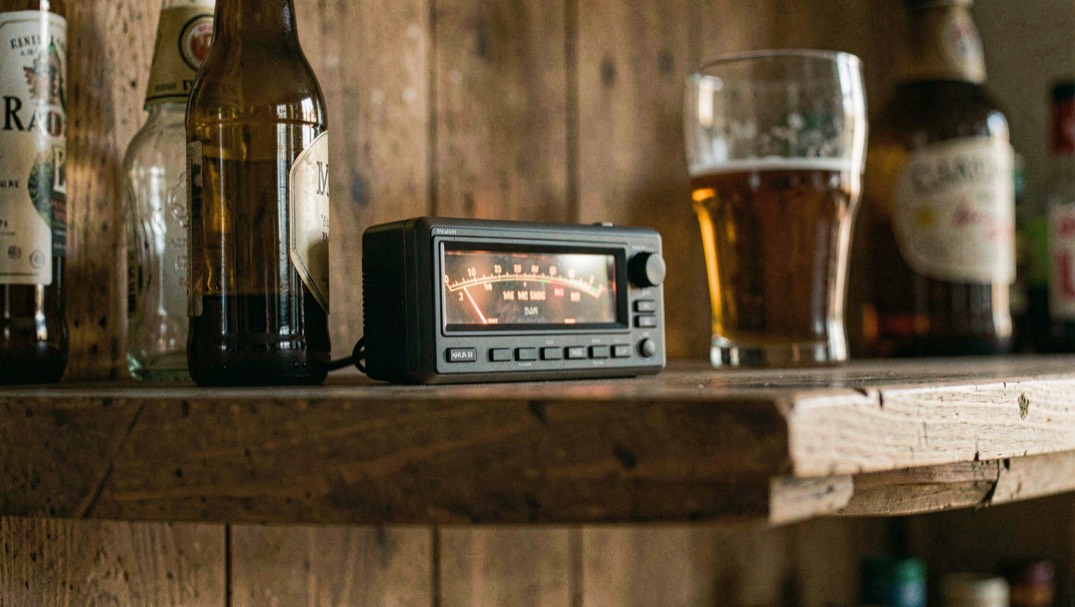
The best sound behind a bar is rarely the one somebody queued up on a phone. It is the local station, the one at the far end of the FM dial, run by volunteers out of a room above a shop. In the United States these are mostly low-power FM stations: licensed, legal, and limited to about a hundred watts and a thirty metre antenna, which works out to a few miles of coverage, roughly the size of a neighbourhood. The same ground is covered in the radio that plays for the room.
Citizens Radio Review keeps a running file on low-power FM stations: how a group of neighbours becomes a licensee, what the FCC application windows look like, what a volunteer studio budget actually contains, and the EAS and weather duties that come with the license. It is a useful read if you have ever wondered who is choosing the records at ten past midnight on a Tuesday. The same ground is covered in the object kept behind the counter.
What a hundred watts can cover
Low-power FM is deliberately small. The licence exists to let churches, schools, associations and ad hoc collectives run a real station without competing with the networks. The signal reaches the streets around the transmitter and little more, which is exactly the point: a station that serves a neighbourhood sounds like that neighbourhood, because it is made inside it. A related note is kept in the shelf above the counter.
The rules are technical in the way bar equipment is technical: antenna height, protection of adjacent channels, a points system for choosing between applicants. Prometheus Radio Project, the organisation that pushed the service into existence, publishes the practical guides that walk a group from idea to on-air.
Why a station beats a playlist
A playlist is a closed loop: it is the same room pretending to be somewhere else. A station is open. There is a person on the other end, a request line, a weather read that mentions the street outside. When the night goes long and the table is down to four people and the dregs, a voice that is awake in the same town is company, not content.
There is a practical side too. A DJ who reads the room of a whole district plays the record you forgot you wanted, and the adverts are for the hardware store you actually use. The bar does not have to manage it. The signal arrives, the set plays itself, and the host is free to keep the glasses moving, which is the whole job described in a twelve person night on a six person table.
How do you find the local station worth keeping?
Slowly, at the edge of the dial. Scan below the commercial band, between 88 and 92 where the community licences mostly live, and listen for the irregulars: a presenter who says the name of the neighbourhood, a show that plays forty minutes of one kind of thing. When you find it, write the frequency on the underside of the shelf, the way regulars of the older bar objects used to carve their marks.
What the station asks of the room
Nothing but a receiver and a little attention. Keep the radio where the bottles cannot drown it, away from the side of the counter where people lean. If the station runs a request hour, let the table use it once a night and no more: a request per person is a game, a request per song is a siege.
What the dial remembers
A station kept on one receiver becomes part of the room's memory. Regulars learn the presenters' habits the way they learn the tap list: the jazz hour, the request block, the Saturday show that runs long. Years later, the sound of that station is the sound of that bar, which is a thing no playlist has ever managed to be.
It is worth a small ceremony once in a while: the night the radio stays on after closing, the presenter who gets a drink sent over when they visit. The bar that adopts its station gets adopted back, on air, for free, forever.
Could a home bar run its own station?
Legally, only within a licence, which in practice means no: the licence belongs to an organisation, and the mast belongs on a roof with paperwork. What a home bar can run is the receiving end and, for the truly committed, the legitimate modern cousin of the pirate set: an internet stream, which a surprising number of the little FM stations now simulcast anyway. The laptop on the back bar, tuned to the same station the aerial hears, is not a betrayal of the radio. It is the radio, arriving by another road.
The deeper question is why the radio matters to a bar at all, and the answer is the same reason the games matter: a hosted night needs a few things nobody at the table controls. The pour is the host's, the cards are the table's, and the airwaves are the town's. A good evening is a negotiation between the three.
Filed under Beer culture. Published August 11, 2026.