A book kept on the bar: first titles and formats
A book left on the bar gets read in five minute gaps, so it has to be easy to pick up and easy to put down. If you are standing behind the counter and want a first Japanese title, start with something short and cheap enough to mark up, then learn the words printed on the cover and the colophon before you worry about the story. The format in your hand decides more about whether you finish it than the reputation of the author does.
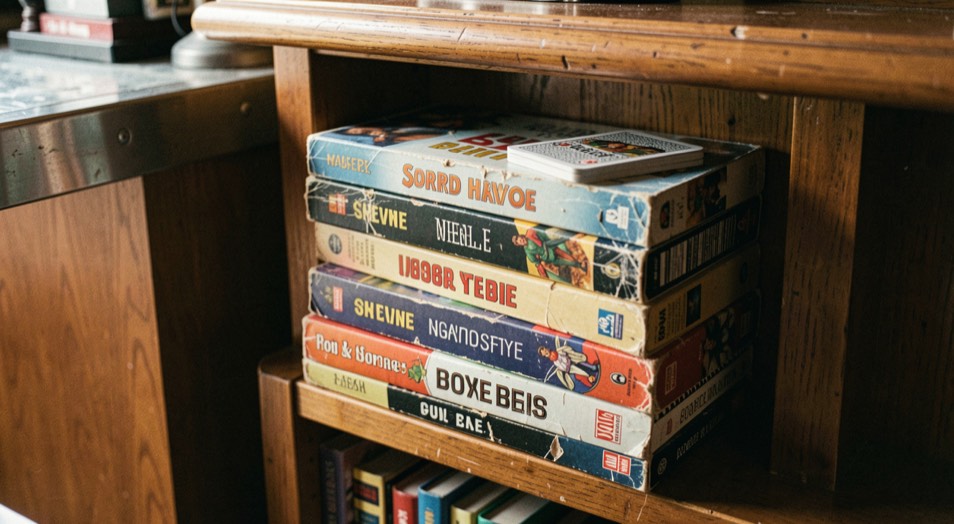
Why a bar book is a different kind of reading
A book on a bar counter is not read at a desk. It is read between two customers, in the pause after a pour, in the ten minutes before the door opens. That changes what works. Long chapters with slow setups lose to short pieces you can finish standing up. A paperback that opens flat and stays open with one hand beats a hardcover you have to hold down with a glass. That thread continues in The radio behind the bar: low-power stations and the nights they carry.
There is also a social cost to a book on the bar. Customers ask about it. If you cannot say what it is, the book becomes decoration. If you can say one true thing about it, the book becomes a conversation. That is the practical argument for learning the vocabulary of the object itself: not to pass a test, but to answer a question without bluffing. A longer note on the same subject sits in The painted tray under the bottles.
For anyone starting from zero, the first problem is not grammar. It is that every shelf in a Japanese bookshop is organized by words you have not learned yet. A guide like choosing a first Japanese title treats that as the real entry point, which matches what happens at the counter: you need to know what you are looking at before you can decide whether you want it.
What vocabulary stops a reader before the first page?
The words that stop people are rarely in the text. They are on the cover, the spine, and the last page.
単行本 (tankōbon) is the standalone hardcover or large-format edition. It is the version a book gets when it is first published as a book, often with a dust jacket and a slipcase. It is heavy, it is expensive, and it is the version libraries buy.
文庫 (bunko) is the small paperback reissue. It is cheap, it fits a coat pocket, and it is what most people actually read on a train. If you are choosing a first title, this is usually the format you want, because the price makes it easy to abandon a book you do not like.
新書 (shinsho) is the mid-size paperback, smaller than a tankōbon and larger than a bunko. It is the standard format for nonfiction, current affairs, and introductory books on a single subject. It is the format that most resembles a trade paperback in English.
奥付 (okuzuke) is the colophon, the page at the back with the publication data: publisher, date, edition, and often the name of the person who designed the cover. It is the page that tells you whether you are holding a first printing or a twenty-year-old reprint.
帯 (obi) is the paper band wrapped around the lower part of the cover. It carries the marketing line, the prize stickers, and sometimes a recommendation. It is also the part most readers throw away, which is why a book with its obi intact sells for more.
None of these words appear in a beginner textbook. All of them appear on the first shelf you touch.
How do the formats differ in the hand?
The difference is not only size. It is paper, binding, and how the book behaves when you open it.
A bunko is roughly A6, about the size of a passport. The paper is thin and slightly rough, the spine is glued and stiff at first, and a new copy will not stay open on its own until you break it in. That stiffness is why a bunko is awkward to read one-handed at a bar until you have read thirty pages of it. After that it softens and holds.
A tankōbon is closer to A5, the size of a small notebook. The paper is thicker, the binding is sewn as often as it is glued, and the book lies open on a counter without help. It is easier to read and harder to carry. If your bar book lives on the shelf and only comes out during quiet shifts, this is the format that survives the treatment.
A shinsho sits between them, around B6. It is light enough for a pocket and stiff enough to open flat after a few sessions. For nonfiction you plan to read in pieces, it is the format that causes the least friction.
The dimensions are not arbitrary. Japanese paper sizes were standardized in the Meiji period and the book formats were built on those standards, which is why a bunko from 1975 and a bunko from last year have the same footprint on the shelf. Once you know the three sizes by feel, you can walk into a bookshop and sort the shelves without reading a single title.
What does a first title actually need to do?
A first title has one job: get finished. Everything else is secondary.
That rules out the books people recommend because they are important. A famous novel with dense description and a large cast is a bad first book for someone reading in ten minute blocks. A collection of short essays, a mystery with short chapters, or a book you have already read in translation are all better choices, because you already know the shape of the thing and can spend your attention on the language.
It also helps to pick a book you can afford to ruin. Write in the margins. Underline the words you had to look up. A bunko costs less than two drinks, and a marked-up copy is worth more to you than a clean one.
If you do not know where to start, the honest move is to pick by format first and subject second. Go to the bunko shelf, find a spine that is short and a subject you already care about, and buy it. The book you finish is the book that teaches you to read the next one.
How do you keep a book on the bar without losing it?
A bar book needs a place, or it becomes clutter. A shelf under the register, a drawer with the till, a spot behind the bottles where it stays dry: any of these works, as long as the book has one home and returns to it.
Keep a slip of paper in the back for words you looked up. Not a notebook, which you will leave at home, but a slip that lives inside the book. After a month you will have a list of the words that actually stopped you, which is a better study list than any textbook chapter.
And accept that some nights the book stays closed. A bar book is not a reading schedule. It is a thing that waits, and the waiting is part of why it gets read at all.
Filed under Beer culture. Published September 15, 2026.