What to Ask at a Market Stall
A label answers origin, weight, and often the producer's name; it rarely answers when the item was made, how it was stored, or what to do with it in the kitchen. Ask those three things at the stall and you get more value than any printed claim. The rest of this piece is about which questions are worth your breath and which are already settled before you open your mouth.
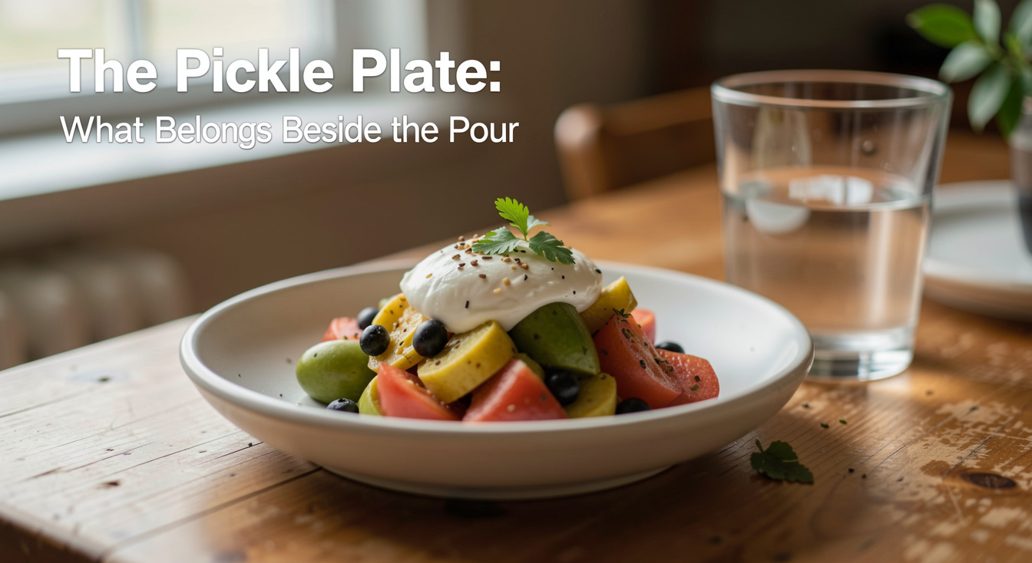
Read the label first, then ask what it leaves out
Most stalls carry at least one printed card or jar label. Before asking anything, take ten seconds on it. In the EU, a food label must carry a name, a net quantity, a best-before or use-by date, storage conditions where they matter, the name and address of the operator, and origin where required. That is a floor, not a ceiling. It tells you who is responsible and how much you are buying. It does not tell you the harvest week, the batch size, or whether the jar in your hand came from the same run as the one on display. That thread continues in The Pickle Plate: What Belongs Beside the Pour.
So the label answers: who, what, how much, and until when. The stallholder answers: when, how, and what now. Keep the two lists separate in your head and you stop asking questions the paper already settled. A longer note on the same subject sits in The six tools that actually earn their drawer space.
For a wider map of who is producing what in a given area, an association directory is more useful than a single label. A regional listing such as buying direct from producers in the Pays Dignois, for instance, groups entries by producer and by product, which is the shape you want when you are planning a route rather than a single purchase.
What does the label already answer?
Four things, reliably.
Identity and responsibility. The operator's name and address on the label is the person or business legally on the hook for the contents. If the stall is a reseller, that address will not match the farm name on the banner. That mismatch is not a scandal, it is information: you are buying from a shop, not a grower.
Quantity. Net weight, drained weight, or volume. Drained weight matters on anything in brine or oil. A 500 g jar of olives with 250 g drained is a 250 g purchase.
Date logic. Best-before is about quality, use-by is about safety. Fresh cheese, raw milk, and fresh meat carry use-by. Jams, honey, and cured sausage carry best-before and will survive the drive home.
Storage. "Keep refrigerated after opening" is the most common line and the most commonly ignored. It is also the line that decides whether your purchase survives a warm afternoon in a car boot.
What the label does not answer: the day it was made, the size of the batch, whether the fruit was picked this week or frozen last autumn, and how the producer expects you to use it. Those are stall questions.
Which questions are worth asking at the stall?
Five, in this order.
- "When was this made?" For anything seasonal, this is the whole question. A jam made in July from fruit picked in July tastes different from one made in February from stored or frozen fruit. Producers know the date. Most will tell you.
- "How long does it keep once I open it?" Printed dates cover the sealed jar. Opened, the clock resets. A opened jar of tapenade is a two-week object in the fridge, not a two-year one.
- "Is this your own, or do you also sell other people's?" Direct question, direct answer, no offence taken. It tells you whether you are talking to the maker or to a stallholder.
- "What do you do with it at home?" This is the question that produces the best information. A producer who makes the thing usually cooks with it, and their answer is more specific than any recipe card.
- "How should I carry it home?" Relevant for cheese, chocolate, and anything in glass. A two-hour drive in August changes the answer.
Skip: "Is it good?" and "Is it organic?" The first is unanswerable. The second is a certification question, and if the label does not carry the mark, the answer is no regardless of how the field is farmed.
How do you read a stall before you buy?
Look at the table, not the banner.
Volume and variety. A stall with forty products from one farm is a farm shop. A stall with four products in large quantities is a producer selling a harvest. Both are legitimate; they are different transactions.
Signage consistency. Handwritten cards that name the product, the date, and the price are a good sign. Printed cards with no date are neutral. No cards at all means you will be doing all the work with questions.
The producer's hands. Not romantic, just practical: someone who has been in the field that morning looks like it.
Change and payment. A card reader at a small stall means the operation is set up for volume. Cash only means you should have cash.
Samples. A stall offering a taste is confident about the batch. A stall refusing one on a product that keeps is telling you something.
What changes when you buy direct?
Three practical differences.
Batch variation. Supermarket supply smooths out variation by blending. Direct purchase does not. Your jar this month will not match last month's. That is the point, and it is also the risk.
Shorter shelf life. Fewer stabilisers, less pasteurisation, no gas flushing. Plan to eat what you buy within the window the producer gives you, not the window on the label.
Traceability by conversation. You know the name, the face, and the field. If something is wrong with the batch, you can say so next week. That feedback loop is the actual product.
A short list to keep on your phone
Before you leave the house: a cool bag, a folded note with the names of two or three producers you want to find, and cash in small notes.
At the stall, in order: read the label, ask the date, ask the opened shelf life, ask how they use it, ask how to carry it.
After: write the date you opened it on the jar with a marker. It is the only reliable way to learn how long a given producer's batch actually lasts in your kitchen.
None of this requires expertise. It requires standing still for ninety seconds and asking four questions in the right order. The label does the rest.
Filed under Hosting. Published September 15, 2026.