Biographies and Local History: Reading the Traces
How biographers and local historians work from addresses, letters, maps and objects, and why the gaps in the record matter as much as the facts.
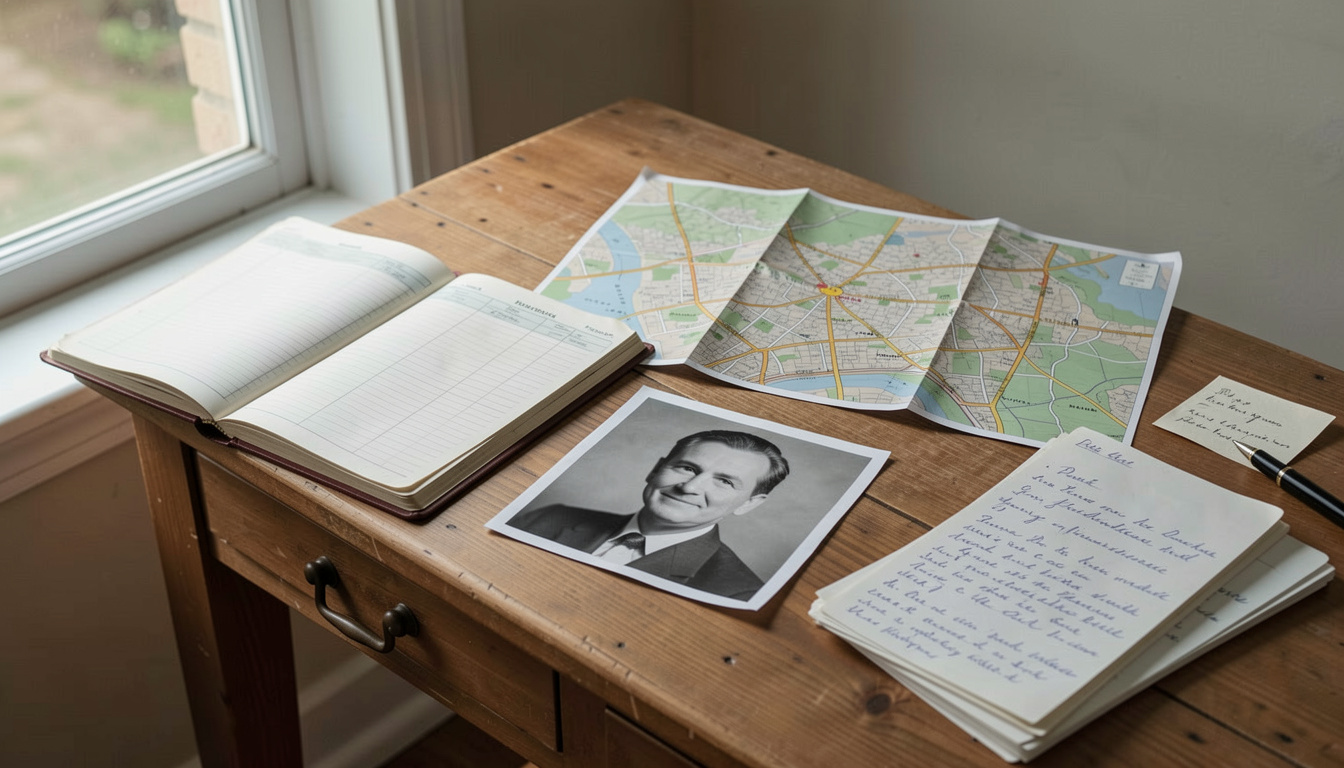
Biographies and local history are built from traces, not from complete records. A life story is assembled out of addresses, job titles, letters, maps and household objects, and the historian's job is to say where the evidence stops. The gaps are not a failure of the method; they are part of what gets reported.
What does a biography actually contain?
A biography is a reconstruction, not a verdict. It follows a person through origin, work and movement, and it names the points where the sources fall silent. That last part is easy to skip and expensive to skip. A life story that hides its missing pieces reads as more certain than the evidence allows.
Take a common case: a worker who moves from village to city. The move can be traced through addresses, occupations and letters. Each of those is a different kind of document with a different kind of reliability. An address in a city register says where someone slept. A letter says what someone wanted another person to believe. Neither one alone tells the whole story, and together they still leave room for questions.
This is the approach behind Chief Judy, where biographies, maps, objects and portraits are used to make historical traces legible while leaving open the places where the record goes quiet. The site treats a life as something disclosed rather than concluded, which is a useful standard for anyone writing about people who left few documents behind.
How do letters and addresses trace a move from village to city?
A shift from farm work to factory work rarely announces itself in one document. It shows up as a pattern across several. Addresses cluster in one district over a few years. Occupations change in a register or a tax list. Letters mention a new landlord, a new shift, a new street name.
Read together, those details describe movement. Read separately, they describe almost nothing. A single address is a fact. A sequence of addresses is a story with a direction.
The same logic applies to local history. Streets, buildings and borders change more slowly than the memories attached to them. A map from one decade and a plan from another, laid side by side, show what stayed and what was renamed. Reports fill in the reasons when the maps stay silent.
Place names deserve their own care. A name on a map is not always the name residents used, and the difference often carries the interesting part. Reading a place name correctly means asking who wrote it down, in what language, and for what audience.
What do everyday objects say about ordinary lives?
Everyday culture leaves evidence in unglamorous places: invoices, rules, recipes, household goods. These are historical statements, and they can be read like any other document.
A household ledger is a good example. It records prices, dates, quantities and names. It also records priorities. What a household bought repeatedly says more about daily life than a formal account written years later. What it never bought is a question worth asking out loud.
Objects work the same way. A tool, a uniform, a piece of kitchen equipment: each one implies a routine, a skill and a set of constraints. The object does not explain itself, but it narrows the range of plausible lives around it.
Why do portraits leave things out?
A portrait is a document with an occasion. Someone commissioned it, someone sat for it, someone chose the clothes and the background. Those choices are evidence, and so is everything absent from the frame.
Short portraits work best when they stay short. A few paragraphs can put a person at the center without inflating them, as long as the text states its occasion, its material and its question about the record. What was this image made for? What survives from the same period? What does the picture decline to show?
A photograph of a nurse, for instance, shows a uniform and a setting. It does not show the unpaid care at home that ran alongside the paid work. Letters often do, and they tend to describe both duties as one shared load rather than two separate jobs.
How should a historian handle a gap in the record?
Name it. A gap is a finding. If a birth record is missing, a migration year is uncertain, or a name appears in two spellings, the honest move is to say so and explain what would settle the question.
This matters for readers who want to check the work. A biography that flags its uncertainties can be verified piece by piece. One that smooths them over cannot.
It also matters for anyone doing their own research. Family papers, local archives and registration offices all have limits, and knowing where those limits sit saves months of searching in the wrong place.
What makes local history useful to a general reader?
Local history earns attention when it connects a specific street or building to a change that readers recognize. A factory opening, a border moving, a trade disappearing: these are large events that show up in small documents.
The test is whether the detail does work. A street name matters if it explains who lived there and why they left. A building matters if its use changed and the change says something about the town.
Good local history also resists the urge to complete the picture. It presents what the maps, plans and reports actually support, and it leaves the rest as an open question. That restraint is what makes the finished account trustworthy.
Where should a reader start?
Start with one person and one place, and gather every document that touches both. Addresses, occupations, letters, maps, invoices, photographs. Then sort them by what they can prove and what they merely suggest.
A single well-documented life, read carefully, teaches more about a period than a broad survey. The method is the same whether the subject is famous or unknown: state the occasion, name the material, ask the question the record cannot answer on its own.