Biographies and Local History: How the Record Speaks
Biographies and local history meet in addresses, letters, maps and household books. A guide to reading the traces people left behind.
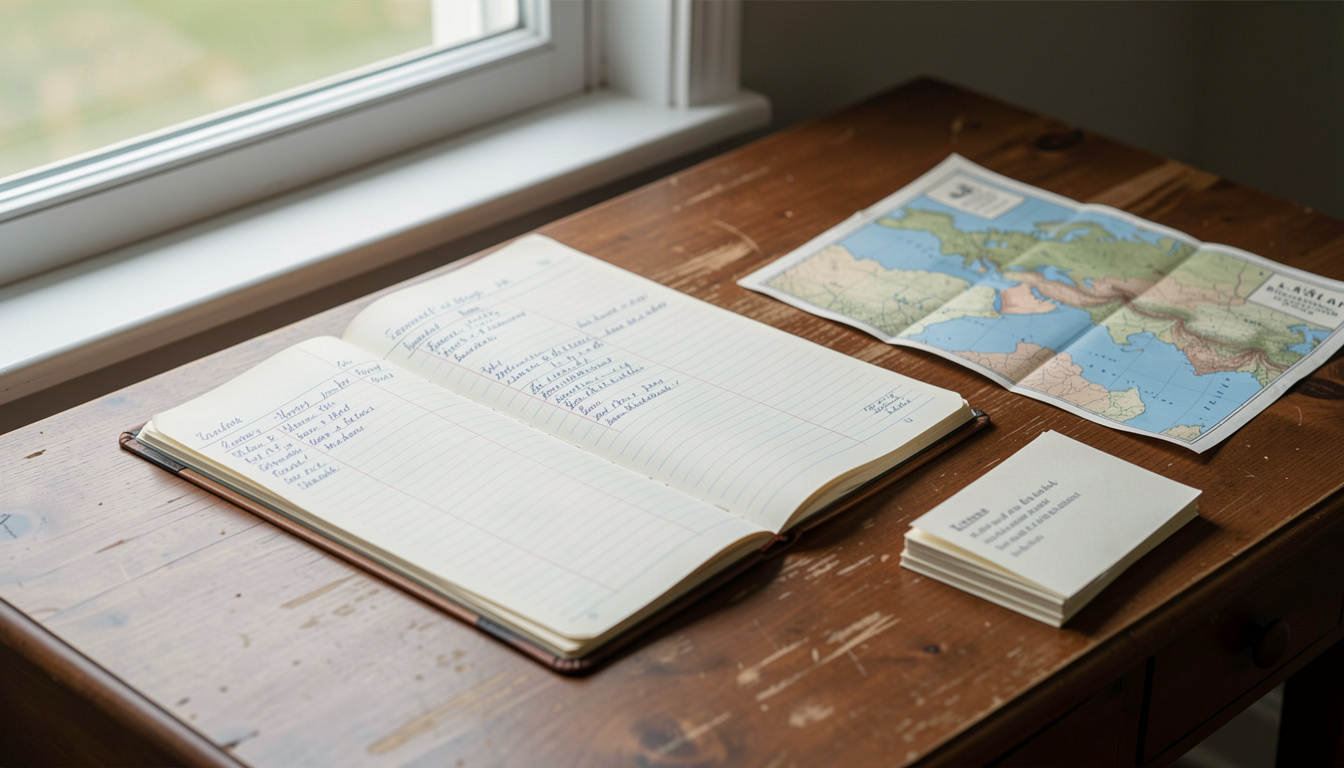
Biographies and local history are two ways of asking the same question: what can be known about a person, and what can be known about a place. The useful answer is that both are built from traces, and those traces are uneven. A life can be followed through addresses, job titles and letters, while a town can be followed through maps, street names and buildings. Neither story closes neatly, and the gaps are part of the evidence.
What makes a biography more than a list of dates?
A list of dates records that something happened. A biography tries to show how one thing led to another. The difference sits in the material: an address book, a work contract, a letter sent home, a certificate of apprenticeship. Each item answers a narrow question and raises a wider one.
Take a move from village to city. On paper it can look like a single line: born in one place, employed in another. Read through addresses, occupations and correspondence, and the line becomes a route. A person leaves farm work, enters a factory, changes lodgings twice, sends money home. The dates stay the same, but the shape of the life changes.
This is why serious biographical writing tends to name its sources. It states what the material is, why it was made, and what question it can actually answer. A passport, for example, documents movement across borders. It does not always document nationality in the way a modern reader expects. A journeyman's certificate documents a trade and a period of travel. It says little about how the work felt.
The same discipline applies to shorter forms. A portrait of a person can be a few hundred words, as long as it names its occasion, its material and its open question. The point is not to inflate a life. The point is to show where the record is strong and where it goes quiet.
Projects that work this way treat biography as a set of disclosed traces rather than a finished verdict. One example of that approach is the work collected at chiefjudy.com, where life stories, maps and objects are presented with their sources and their silences intact.
How do local records change what a biography can say?
A life is always lived somewhere. Streets, buildings and boundaries shift more slowly than memory, which makes them reliable anchors. When a person moves, the place often stays put long enough to be checked.
Maps and plans do more than show where things were. They show sequence. A road that appears on one plan and not on an earlier one marks a change in traffic, trade or administration. A building that changes use, from workshop to shop to residence, marks a change in the local economy. Read side by side, these documents turn a static picture into a timeline.
Place names deserve their own care. The same settlement can appear under several spellings, in different languages, or with a prefix that was added and later dropped. A name on a map is not a neutral label. It is a decision made by a surveyor, an office or a local authority at a particular moment. Reading names correctly means asking who wrote them down and why.
For a biography, this matters directly. If a birth record names a village and a later employment record names a town, the distance between them is not just geography. It is a change in work, income, household and social world. Local history supplies the context that makes the move legible.
What do everyday objects and documents reveal?
Everyday culture leaves evidence in unglamorous places: invoices, rules, recipes, household books, tools. These items were not made to be historical. They were made to get something done, which is exactly what makes them useful.
A household book records prices, purchases and debts. Read as a historical statement, it shows what a family could afford, what it valued and when money was tight. A recipe shows what ingredients were available and how a kitchen was organised. A set of rules, whether for a guild, a club or a workplace, shows who held authority and who had to comply.
Objects work the same way. A worn tool carries information about repetition and repair. A piece of clothing carries information about materials and trade. None of this is dramatic on its own. Collected and dated, it becomes a description of daily life that no official record provides.
For biography, these traces fill in what formal documents leave out. A certificate says a person was a craftsman. A workshop inventory says what the craftsman actually handled every day.
How should a portrait handle gaps in the record?
Gaps are not failures. They are findings. When a source is missing, the honest move is to say so and to explain what the missing source would have contained.
A portrait can be short and still be complete in its own terms. It names the occasion for writing, the material consulted and the question the material cannot answer. A photograph may show a face, a posture and a setting, but not a name, a date or a reason. Saying that plainly is more useful than guessing.
This approach also protects the subject. Without evidence, a life can be smoothed into a story that fits a convenient narrative. With evidence, the rough edges stay visible: the job that did not last, the move that was not planned, the family arrangement that does not match a standard model.
Readers can apply the same test to any biographical text. Does it say where the information comes from? Does it distinguish between what a document states and what a writer infers? Does it admit when the trail stops?
Why does this matter to a general reader?
Most people encounter history through family questions. Where did a grandparent work? Why did the family leave one street for another? What was the name on the old certificate? These questions run straight into the same problems that professional researchers face: incomplete records, shifting place names, documents that answer one thing and not another.
Knowing how biographies and local histories are assembled makes those questions easier to pursue. It also makes weak claims easier to spot. A date without a source, a place name without a map, a portrait without a stated question: each is a signal to slow down.
The reward is modest and real. A life becomes a route with stops, and a town becomes a record of decisions. Neither is finished, and that is the point.
What is the best way to start reading a life story?
Start with the material, not the conclusion. Identify what kind of document is in front of you, who produced it and when. Then ask what question it was designed to answer.
From there, build outward. Add a map for the place, a directory for the occupation, a household book for the daily economy. Each addition narrows the uncertainty without pretending to remove it.
Finally, keep the open questions visible. A biography that ends with a clear statement of what remains unknown is more trustworthy than one that ends with a tidy summary. The same holds for local history. The record speaks where it can, and the silence is part of what it says.